- Home-care websites often begin with broad compassion claims before explaining what the agency actually does, what it cannot do, or how a family should decide whether to call.
- The older adult is frequently treated as the subject of a family decision rather than a participant whose routines, preferences, privacy, and independence shape the plan.
- Non-medical home care, home health, skilled nursing, memory support, and emergency services blur together, creating avoidable risk and confusion.
- Caregiver matching is reduced to a reassuring promise instead of a visible process involving fit, role clarity, observation, supervision, feedback, and change.
- Pricing stays hidden behind lead forms, while families lack even a responsible range or explanation of the variables that affect cost.
- Caregiver recruitment is treated as a secondary job board rather than the other half of delivering reliable care.
TRANSFORIO / QA
Releasechecked
ALDERWAY HOME CARE- QC-01Works on every screenNo sideways scrolling at 390, 768, 1440 px wide, on its page.PASS
- QC-02Accessibility0 WCAG 2.1 A/AA or best-practice violations from axe-core on its page, re-checked in every open menu, tab and panel at desktop and phone width. A skip link comes first, every keyboard stop shows focus, and tab widgets answer to arrow keys.PASS
- QC-04SEO fundamentalsTitle, description, a single main heading, language and viewport are set on its page.PASS
- QC-06Links4 internal links checked; none broken.PASS
Automated checks on every page found by crawling the production build, run October 1, 2026. Speed is measured on live hosting at launch, and forms are tested end to end, so neither is claimed here.
The agency was fictional. The family decision was treated as real.
The exercise begins where families actually begin: something changed, they do not yet know the service name, and they need clarity without losing the older adult's voice.
- Business
- Non-medical support for older adults at home
- Audience state
- Families balancing urgency, uncertainty, privacy, and independence
- Primary offer
- A responsible first conversation—not an instant care promise
- Decision barriers
- Fit, boundaries, continuity, cost, safety, and family roles
- Second audience
- Caregivers evaluating the work, expectations, and support
- Industry visual system
- A timetable editorial system built on the arc of a single day: the page travels dawn to night (06:55–21:30) with a persistent time rail, mono timestamps, and a light shift from warm bone to dusk ink. Fraunces display serif, Instrument Sans, and IBM Plex Mono pair with ink, bone, and a cobalt signal color; original documentary photography is art-directed per crop. It feels precise and humane without borrowing hospital blue, sentimental stock imagery, or generic senior-care iconography.
Compassion earns attention. Operational clarity earns the call.
Every major section resolves a real decision: what kind of help may fit, what stays outside the role, how matching should work, what cost depends on, and how the person receiving care participates.
- Lead with preserving ordinary life—not fear, frailty, or a promise to take control.
- Begin the decision journey with what changed in the household instead of asking visitors to diagnose a service category.
- Create an interactive care-path finder that offers useful orientation while clearly refusing to assess, diagnose, determine eligibility, or promise availability.
- Show matching as a six-step working relationship, separating setup from ongoing supervision and adjustment.
- Make non-medical boundaries prominent and repeat emergency direction where families may need it.
- Provide illustrative pricing context while explaining why schedule, location, tasks, continuity, and staffing still require a conversation.
- Build a dedicated caregiver path with candid expectations, role boundaries, hiring stages, and no false promise of placement.
- Keep sensitive medical and employment information off the sample forms and state that demonstration entries are neither transmitted nor stored.
One showcase. Two audiences. No borrowed reassurance.
The result demonstrates how a complex, trust-sensitive service can be warm, candid, useful, and conversion-minded without hiding its boundaries or inventing proof.
- A responsive single-page showcase structured as one ordinary day (06:55–21:30), with a persistent time rail and dawn-to-night light arc that turn the care philosophy into the page architecture itself.
- An interactive seven-situation orientation tool that turns uncertainty into a responsible next conversation while clearly refusing to assess, diagnose, determine eligibility, or promise availability.
- A day timetable showing how preference, privacy, errands, and family communication anchor the plan — with 'care fits here' annotations marking where a caregiver's hours actually land.
- A six-step matching process covering listening, role definition, genuine fit, introduction, supervision, and change, split into relationship setup and ongoing phases.
- Plain-language home-care versus home-health boundaries and guidance for situations requiring another qualified provider.
- Illustrative cost ranges, visit minimums, benefit caveats, and the factors a real agency must verify.
- Six questions every family should ask, each paired with why it matters and what a straight answer sounds like.
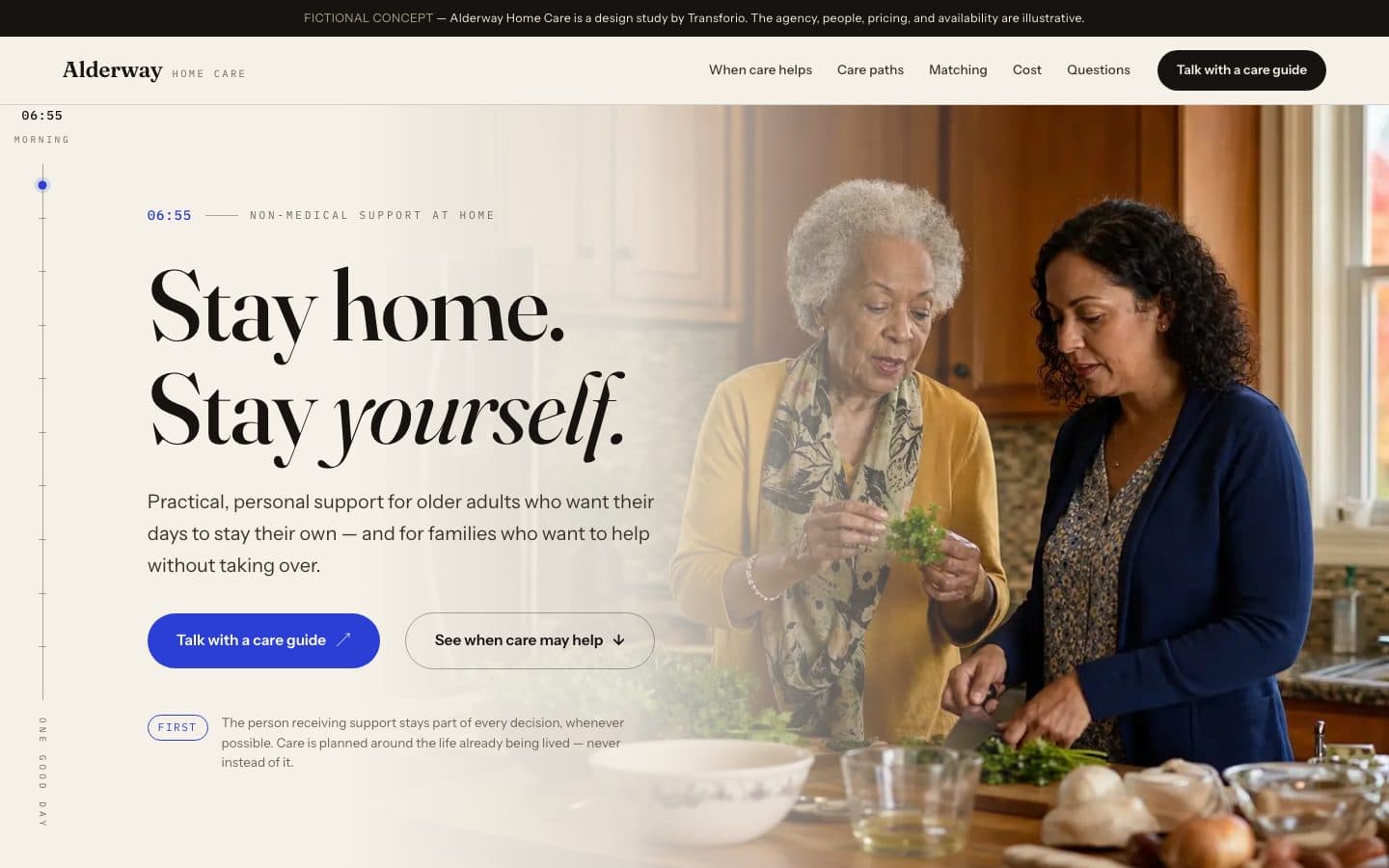
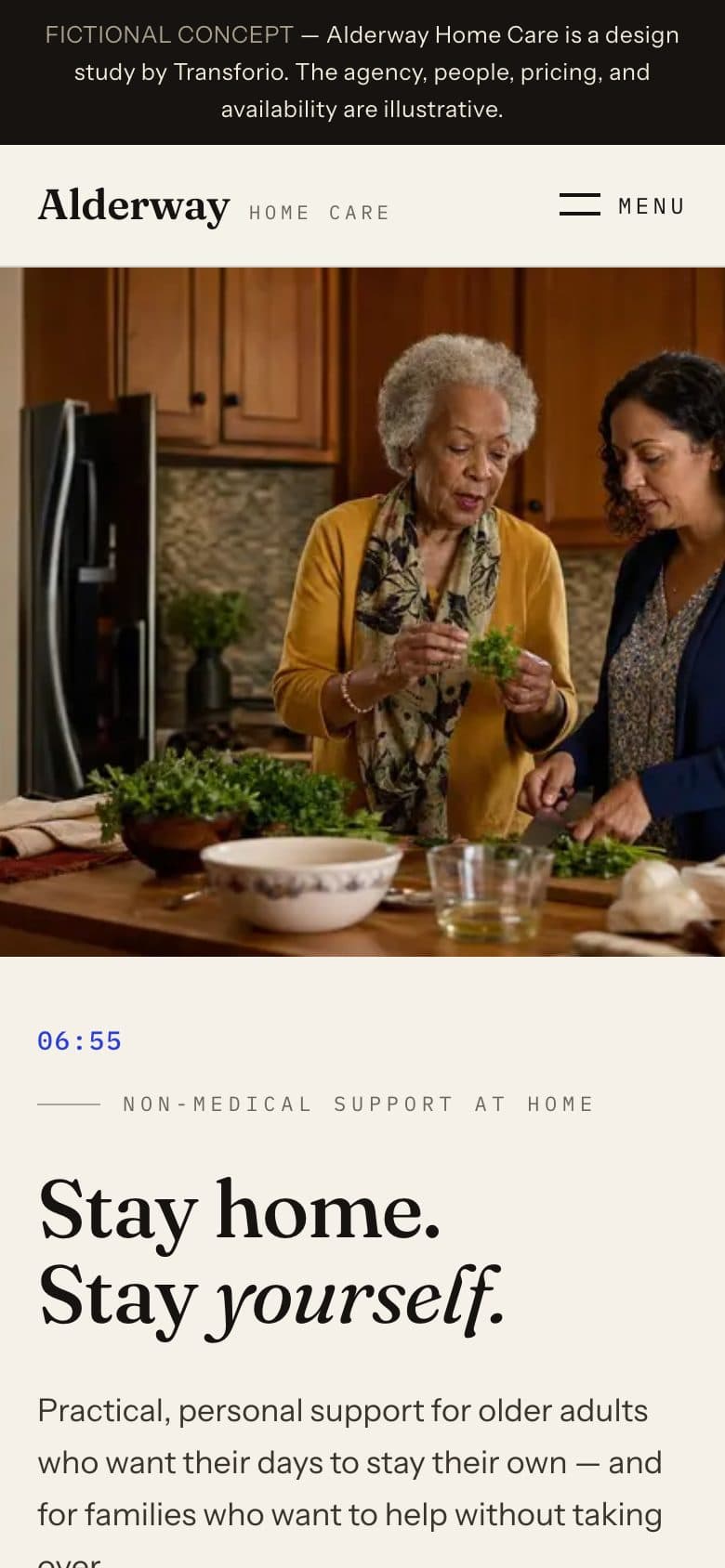
- Three original documentary-style images centered on participation, conversation, and everyday life rather than dependency — each used exactly once.
- Hero promise → talk with a care guide or explore when care may help
- What changed → receive general orientation and relevant planning questions
- Care paths → understand possible non-medical support and boundaries
- Matching process → see how fit becomes an ongoing working relationship
- Cost context → enter the conversation with realistic expectations
- Six questions → arrive at the first call already knowing what to ask
- Night CTA → a low-pressure phone-first conversation
- Next-morning epilogue → hire Transforio to make a complex service easier to choose
Disclosure
Alderway Home Care, its team, address, phone number, services, pricing, availability, employment opportunities, operating standards, and family situations are fictional. Original images are illustrative scenes created for this showcase. The concept demonstrates Transforio's real strategy, design, and implementation judgment; it is not a client engagement or a claim of care, employment, or business results.