- A typical med-spa homepage leads with devices, discounts, and treatment names before a prospective patient understands which concern those options address.
- The category often implies guaranteed transformation through polished before-and-after imagery without enough context about candidacy, session count, recovery, or individual variation.
- Downtime and price appear late—or only after a lead is captured—even though both are central to a patient's decision.
- Consultation forms frequently invite sensitive medical detail into a general website form before the practice has established a secure clinical context.
- Provider biographies can rely on unverifiable credential lists and awards instead of showing how the clinician actually approaches a recommendation.
- Event-driven visitors are encouraged to book quickly even when responsible timing may require a longer runway, a lighter option, or no treatment.
Industry spec 03 · Cosmetic dermatology
Fictional practice · not client workEllery Dermatology & Aesthetics
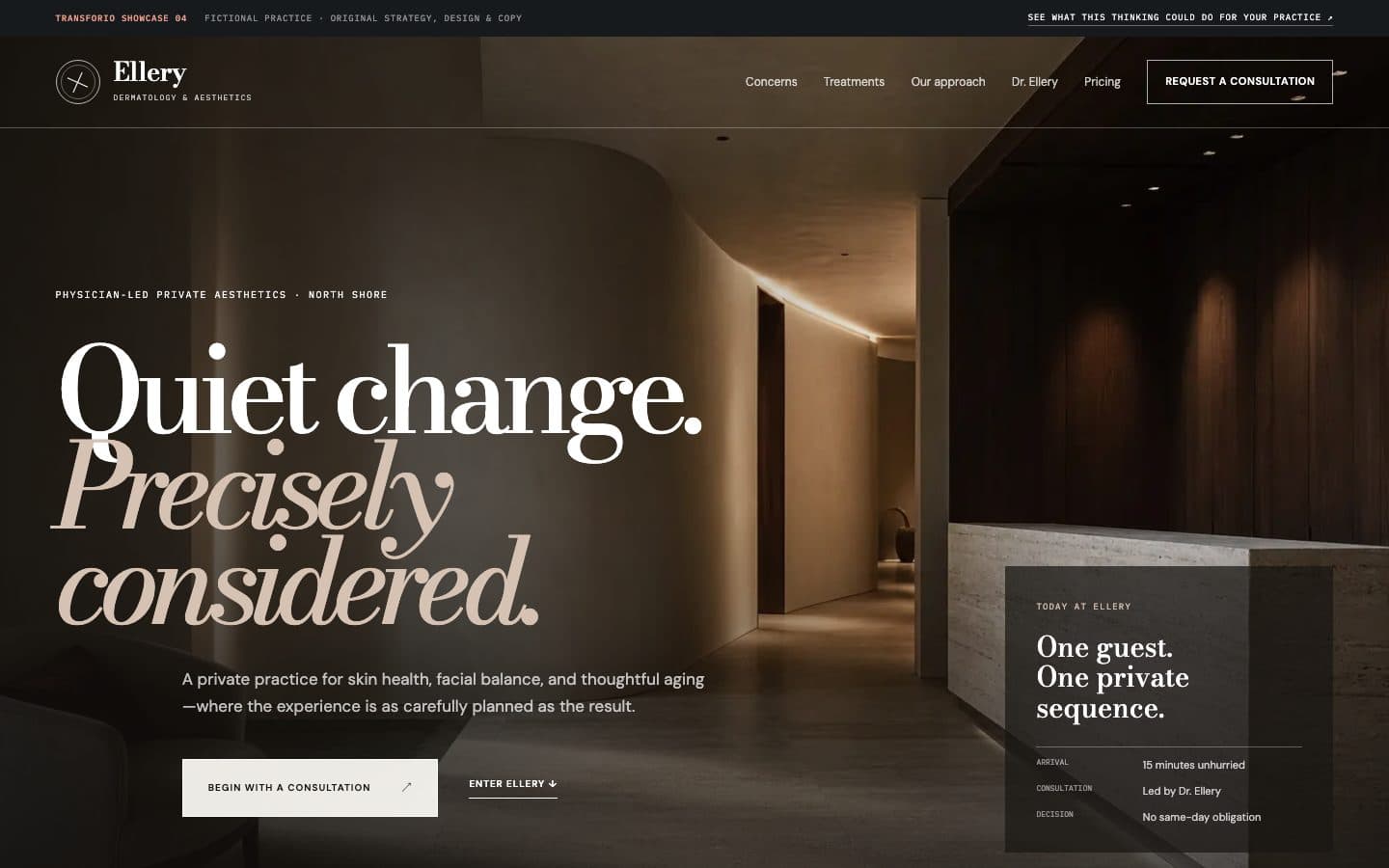
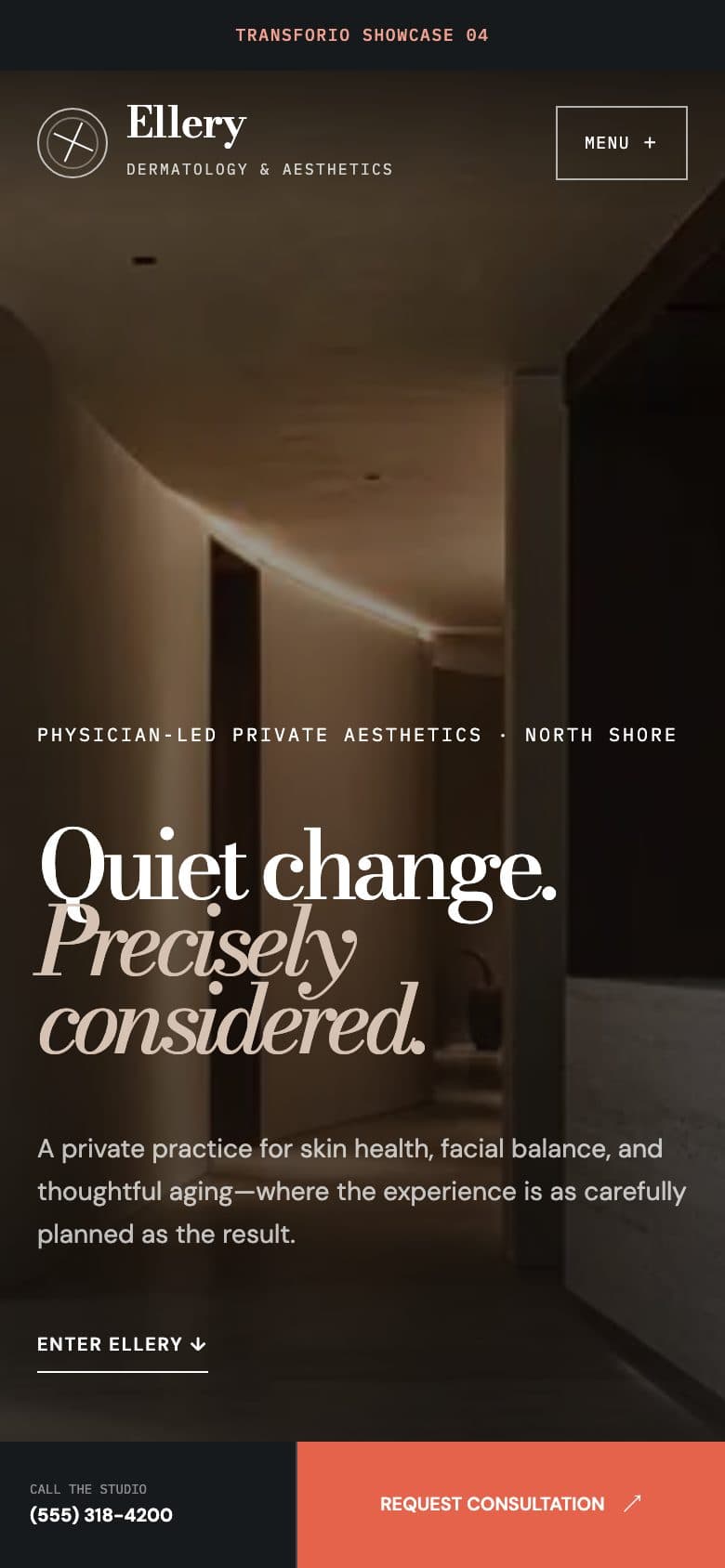
A physician-led aesthetics concept that replaces treatment-menu selling with careful decision support—helping prospective patients understand fit, recovery, timing, cost, and the option to wait before they request a consultation.
TRANSFORIO / QA
Releasechecked
ELLERY DERMATOLOGY & AESTHETICS- QC-01Works on every screenNo sideways scrolling at 390, 768, 1440 px wide, on all 3 of its pages.PASS
- QC-02Accessibility0 WCAG 2.1 A/AA or best-practice violations from axe-core on all 3 of its pages, re-checked in every open menu, tab and panel at desktop and phone width. A skip link comes first, every keyboard stop shows focus, and tab widgets answer to arrow keys.PASS
- QC-04SEO fundamentalsTitle, description, a single main heading, language and viewport are set on all 3 of its pages.PASS
- QC-06Links4 internal links checked; none broken.PASS
Automated checks on every page found by crawling the production build, run October 1, 2026. Speed is measured on live hosting at launch, and forms are tested end to end, so neither is claimed here.
The practice was fictional. The uncertainty around aesthetic treatment was not.
The exercise starts where many cosmetic websites lose trust: a person knows what they notice, but not which treatment fits, what recovery requires, how much it may cost, or whether doing anything is the right choice.
- Business
- Physician-led cosmetic dermatology practice
- Audience state
- Interested, comparison-shopping, cautious, and outcome-aware
- Primary offer
- A consultation that turns a concern into an informed plan
- Decision barriers
- Suitability, downtime, timing, cost, risk, and over-treatment
- Primary conversion
- Request a consultation without disclosing sensitive medical detail
- Industry visual system
- A modern clinical-editorial system built from deep forest, warm ivory, coral, and quiet mineral tones. Original consultation and treatment-preparation imagery, expressive serif headlines, measured rules, restrained motion, and dense-but-readable planning tools position the practice as premium without falling into spa clichés or sterile medical minimalism.
The site earns attention by making restraint more persuasive than a promotion.
Instead of starting with a treatment catalog, the experience helps someone ask better questions, see the limits as clearly as the possibilities, and understand what a responsible provider should evaluate.
- Organize the first exploration around what a person notices rather than asking them to choose a device or procedure they may not understand.
- Make clinical restraint a visible reason to trust the practice: waiting, choosing an alternative, or doing nothing remain valid outcomes of the consultation.
- Put sample cost, appointment length, and downtime beside each treatment path, with clear language that final recommendations require individual assessment.
- Explain a five-step consultation framework so the conversion feels like a decision-making service rather than a sales appointment.
- Replace fabricated transformation photos with a results standard that explains lighting, context, permission, and the limits of individual examples.
- Give high-intent visitors a substantive treatment-detail page that covers candidacy, recovery, alternatives, and questions to bring.
- Use a calendar-based event planner to show why timing belongs in treatment selection without turning general guidance into medical advice.
- Keep the consultation request intentionally minimal and state that the fictional form does not transmit or store submitted information.
A premium clinical experience designed around the quality of the decision.
The result combines editorial storytelling with useful planning tools, substantive treatment education, transparent sample pricing, and a consultation path that respects privacy and autonomy.
- A standalone, responsive cosmetic dermatology showcase with a distinct clinical-editorial identity and original imagery.
- A concern navigator that turns common goals into the questions a responsible consultation should ask before naming a procedure.
- Six purpose-led treatment pathways with general appointment, downtime, and sample-pricing context.
- The Ellery Plan: a five-step consultation journey from the patient's observation to a written sequence and pressure-free decision.
- A transparent fictional provider introduction that intentionally avoids invented education, certification, membership, award, and outcome claims.
- An interactive event planner that works backward from a meaningful date and keeps suitability and recovery decisions with the provider.
- A detailed fractional laser resurfacing page covering candidacy, recovery, alternatives, limitations, and consultation prompts.
- A privacy-aware consultation experience that asks only for scheduling context and clearly explains its demonstration-only behavior.
- Visible disclosures separating fictional people, pricing, contact details, and practice operations from Transforio's real strategy and design work.
- Hero promise → request a consultation or explore by concern
- Concern navigator → understand the questions behind an appropriate plan
- Treatment architecture → compare purpose, downtime, timing, and sample cost
- Ellery Plan → see exactly what the consultation provides
- Provider point of view → build confidence in conservative recommendations
- Event planner → translate a deadline into a responsible planning conversation
- Laser detail page → evaluate candidacy, recovery, alternatives, and limitations
- Consultation page → submit a minimal, privacy-aware request
- End-of-spec explanation → contact Transforio
Disclosure
Ellery Dermatology & Aesthetics, Dr. Maya Ellery, its team, location, phone number, pricing, availability, financing, and operating details are fictional. This concept demonstrates Transforio's strategy, design, and implementation judgment; it is not a client engagement, medical advice, or a claim of treatment or business results.