- The original site reads like a résumé: credentials and admissions come before any recognition of what the prospective client is experiencing.
- The most important differentiator—direct advice and realistic expectations—is buried instead of shaping the first impression.
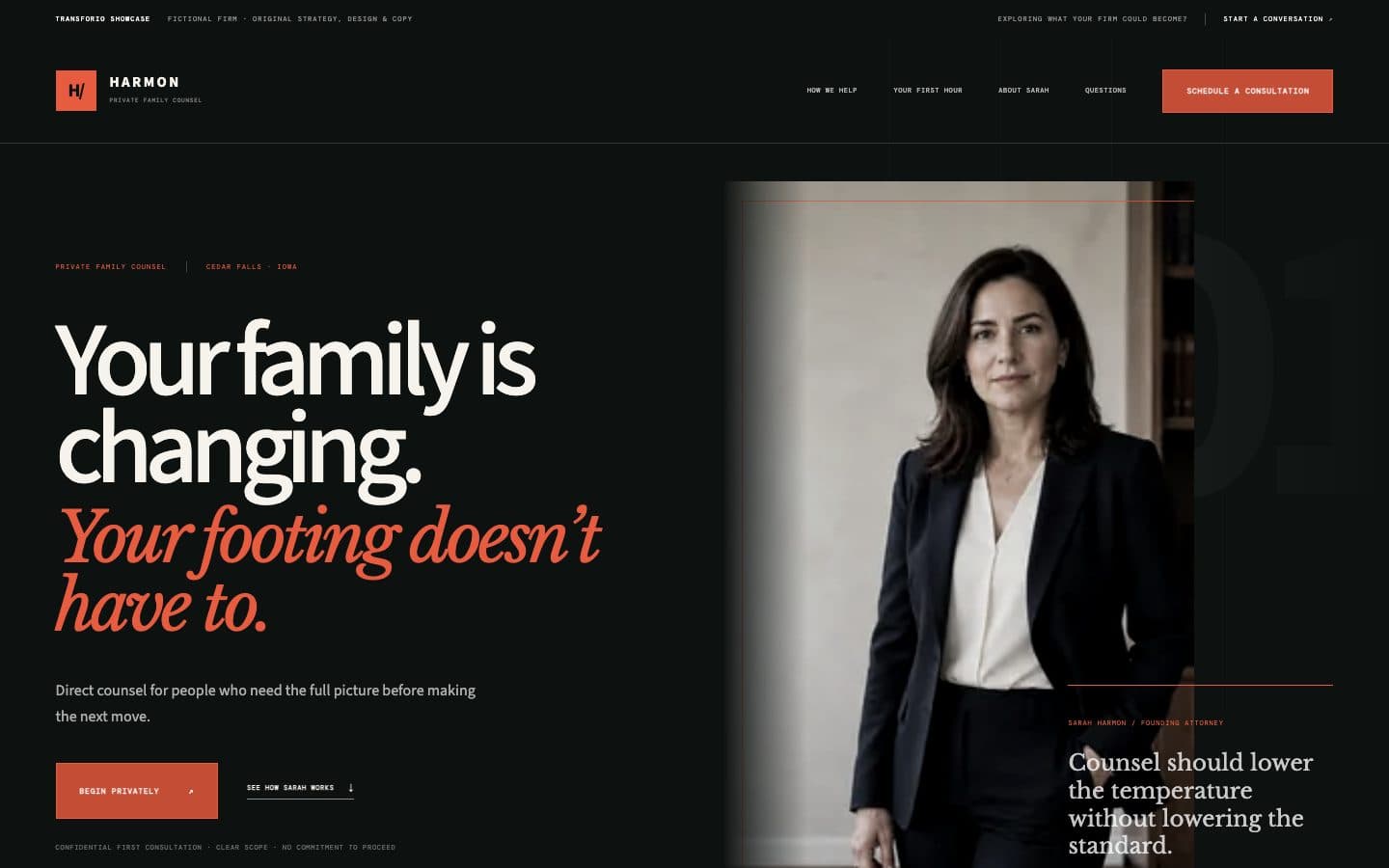
- No attorney portrait appears above the fold, even though trust in the individual is the product for a solo practice.
- The site never explains what happens after someone reaches out, leaving fear of the unknown as an unresolved conversion barrier.
- Practice areas appear as legal categories rather than situations, decisions, and outcomes a prospective client recognizes.
- Testimonials are visually minimized instead of supporting the firm's direct, calm, and responsive positioning.
- The contact form requests case details before a relationship exists, creating unnecessary friction and privacy anxiety.
TRANSFORIO / QA
Releasechecked
HARMON FAMILY LAW- QC-01Works on every screenNo sideways scrolling at 390, 768, 1440 px wide, on its page.PASS
- QC-02Accessibility0 WCAG 2.1 A/AA or best-practice violations from axe-core on its page, re-checked in every open menu, tab and panel at desktop and phone width. A skip link comes first, every keyboard stop shows focus, and tab widgets answer to arrow keys.PASS
- QC-04SEO fundamentalsTitle, description, a single main heading, language and viewport are set on its page.PASS
- QC-06Links2 internal links checked; none broken.PASS
Automated checks on every page found by crawling the production build, run October 1, 2026. Speed is measured on live hosting at launch, and forms are tested end to end, so neither is claimed here.
The firm was fictional. The client anxiety was not.
The exercise begins with a believable solo practice whose strongest asset—direct, realistic counsel—is buried beneath résumé language and a vague contact experience.
- Business
- Solo family law practice
- Audience state
- Overwhelmed, private, and unsure what comes next
- Entry offer
- Flat-fee 60-minute working consultation
- Primary conversion
- Schedule a consultation without sharing case details
- Industry visual system
- A composed editorial system built from ink navy, muted wine, parchment, walnut, and aged-brass tones; expressive serif typography; precise information rails; one consistent attorney portrait; and deliberate changes in section pace. It feels personal and established without relying on gavels, courthouse columns, scales of justice, or a generic corporate-law template.
The design starts with the decision the client is afraid to make.
Every visual and conversion choice responds to a concrete obstacle: uncertainty, privacy, credibility, or fear of being pressured before the facts are understood.
- Open with the visitor's uncertainty and the firm's point of view: when everything feels uncertain, start with the truth.
- Turn the 60-minute flat-fee consultation into a named working session with a clear agenda, outcome, and no implied commitment.
- Show Sarah prominently and reuse one consistent identity throughout the experience so the person visitors meet online feels credible.
- Frame practice areas around the client decisions involved—not as six interchangeable service cards.
- Replace generic credential claims with supportable operating facts, plain-language counsel, team structure, and response expectations.
- Use a varied editorial journey so each section reduces a different objection and the site never becomes a repeated grid of components.
- Ask only for name, contact information, area of law, and preferred contact method; sensitive details belong in the consultation.
A professional-services site organized around clarity, not credentials.
The result gives a prospective client emotional recognition, a credible person to trust, a concrete first step, and enough practical information to act without surrendering private details online.
- A standalone, responsive family-law showcase with its own typography, palette, navigation, interaction, and conversion system.
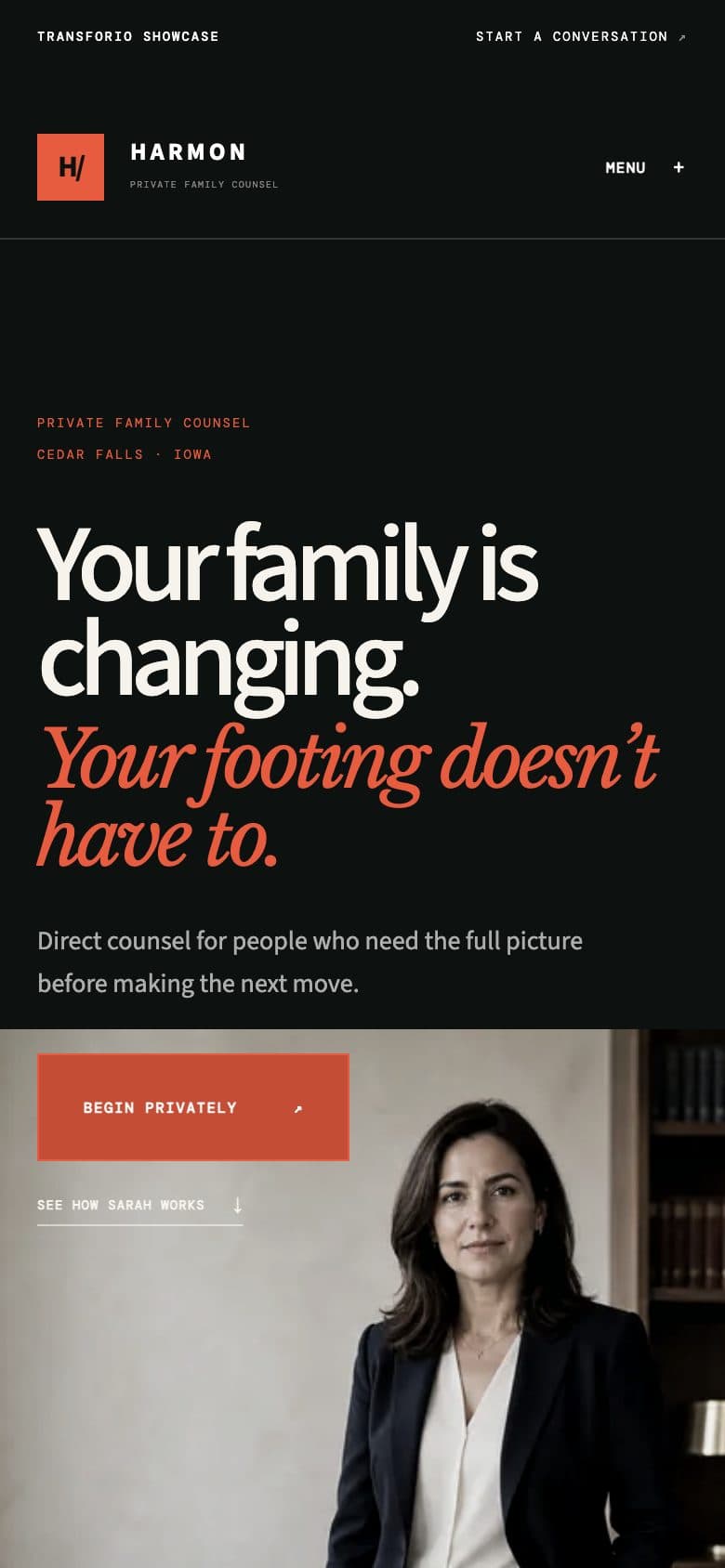
- An original editorial attorney portrait composed specifically for the hero and reused consistently in the About section.
- A cinematic opening that pairs emotional recognition with one clear consultation action and a concrete risk-reversal statement.
- A situation-led practice-area index, a named 'Your first hour' process, an attorney point-of-view section, editorial-scale sample testimonials, and useful pre-call questions.
- An accessible sample consultation form that validates locally, requests no case narrative, and clearly states that demonstration data is not transmitted.
- Visible disclosures separating fictional sample content from real legal claims and separating the fictional firm from Transforio's final invitation.
- A final Transforio section that explains the strategic work demonstrated and links directly to a real conversation.
- Hero → schedule a consultation
- Hero secondary action → understand the first hour
- Practice situation → consultation request
- First-hour explanation → reserve a session
- FAQ → ask a different question
- Consultation section → form or one-tap phone call
- End-of-spec explanation → contact Transforio
Disclosure
Harmon Family Law, Sarah Harmon, its phone number, location, testimonials, and operating details are fictional. This concept demonstrates Transforio's strategy and design judgment; it is not legal advice, a client engagement, or a claim of business results.
Experience the full site