- Template vet site leads with 'We love your pets like our own' — an unverifiable claim every competitor makes, with nothing a worried owner can act on.
- No guidance on what counts as urgent. Owners either panic-drive to an emergency hospital for a routine issue or wait too long on a real one.
- Services listed as a flat menu (wellness, dental, surgery) with no explanation of how medicine is actually practiced or decided.
- No pricing information anywhere. Cost anxiety is a leading reason owners delay veterinary visits.
- No acknowledgment that cats experience vet visits differently — despite cats being the most under-visited patients in the category.
- Online booking implies emergencies can be handled by form. No responsible escalation language anywhere.
Industry spec 08 · Veterinary care
Fictional practice · not client workNorthline Veterinary Clinic
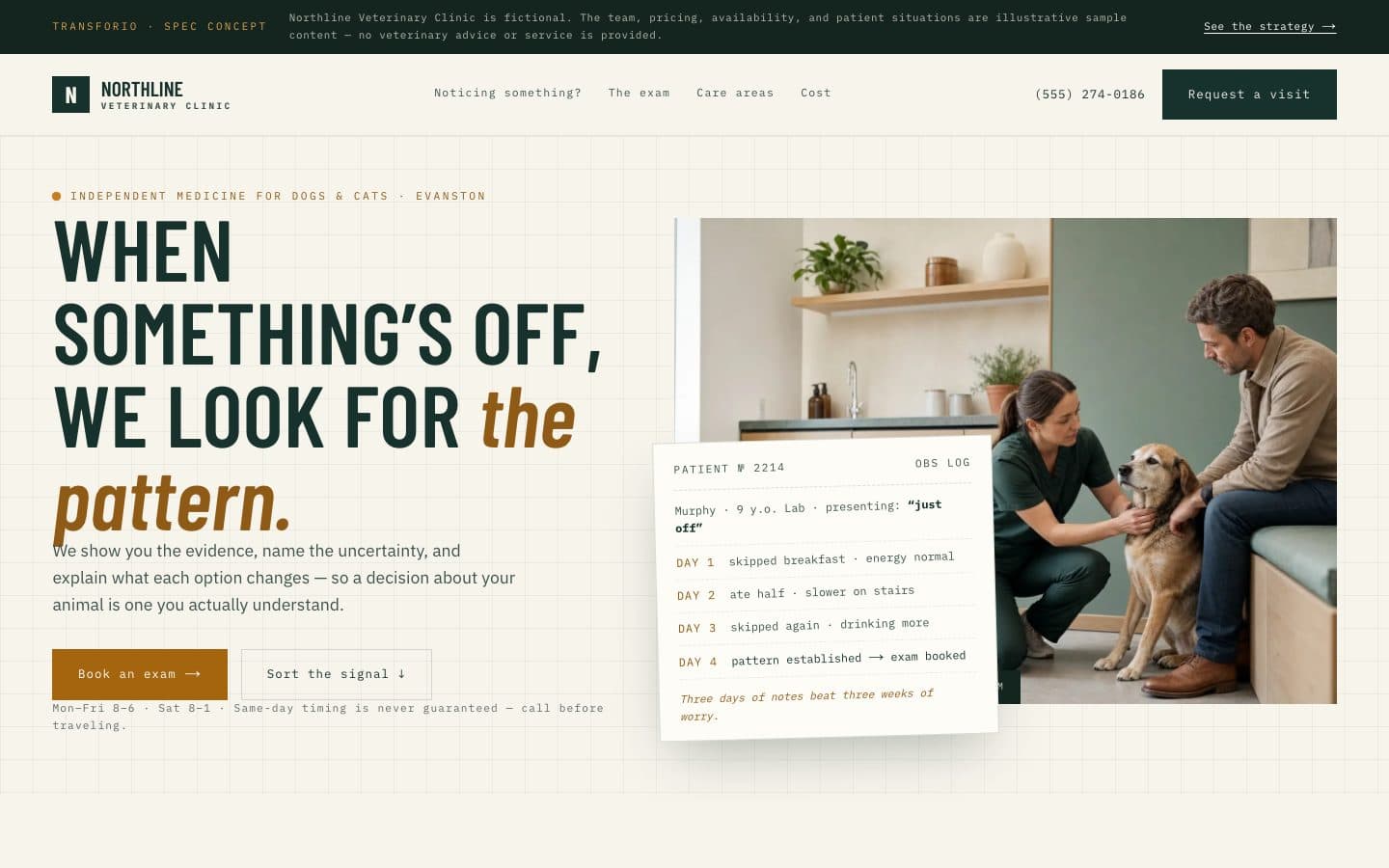
A veterinary concept that differentiates through visible clinical reasoning: a symptom-timing field guide, an exam explained as five questions, honest cost ranges, and responsible urgency guidance instead of generic 'we love pets' warmth.
TRANSFORIO / QA
Releasechecked
NORTHLINE VETERINARY CLINIC- QC-01Works on every screenNo sideways scrolling at 390, 768, 1440 px wide, on its page.PASS
- QC-02Accessibility0 WCAG 2.1 A/AA or best-practice violations from axe-core on its page, re-checked in every open menu, tab and panel at desktop and phone width. A skip link comes first, every keyboard stop shows focus, and tab widgets answer to arrow keys.PASS
- QC-04SEO fundamentalsTitle, description, a single main heading, language and viewport are set on its page.PASS
- QC-06Links2 internal links checked; none broken.PASS
Automated checks on every page found by crawling the production build, run October 1, 2026. Speed is measured on live hosting at launch, and forms are tested end to end, so neither is claimed here.
The clinic was fictional. The 9pm worry was not.
The exercise begins with a capable neighborhood practice whose most persuasive facts—clinical method, honest timing guidance, cost transparency, and cat-considerate care—are buried inside a familiar 'we love pets' template.
- Business
- Independent veterinary clinic for dogs and cats
- Audience state
- Worried, searching symptoms, unsure how urgent it is, cost-conscious
- Primary offer
- Understandable medicine with visible reasoning and online visit requests
- Special populations
- Senior pets and stress-sensitive cats, each with a named care approach
- Primary conversion
- Request a visit or call the clinic
- Industry visual system
- A field-journal system built from chart-paper grid texture, condensed uppercase typography, pine ink and amber markings, observation-log artifacts, and range-bar cost visualization. It feels clinical and human at once — no paw prints, no stock puppy photography, no generic vet template.
The design starts with the question every worried owner is asking.
Every major section resolves a practical barrier—whether this is urgent, how the medicine is actually practiced, what it might cost, whether a cat will be handled patiently, and when a different destination is the right one.
- Differentiate on visible clinical method, not warmth: owners can't judge medical skill, so they judge whether the reasoning is shown to them.
- Lead the page with a symptom-timing field guide — the single most valuable thing a worried owner can use at 9pm — while explicitly stating it is not a diagnosis.
- Explain the exam as five questions that turn evidence into a decision, making the consultation itself the product.
- Publish honest cost ranges with visual range bars and plain fine print, rather than hiding all pricing behind 'call for a quote.'
- Give cats a named, designed visit experience — quieter arrival, patient pacing — because the visit is part of the medicine.
- Name exactly when the clinic is the wrong destination, with a dedicated emergency-honesty section. Responsible refusal builds more trust than overpromising.
A veterinary website that proves the medicine instead of claiming the warmth.
The result turns clinical reasoning into something an owner can follow and use, converts cost and urgency anxiety into visible structure, and earns trust even when it refers a patient away.
- A standalone responsive concept organized around the owner's observation, not the clinic's service list.
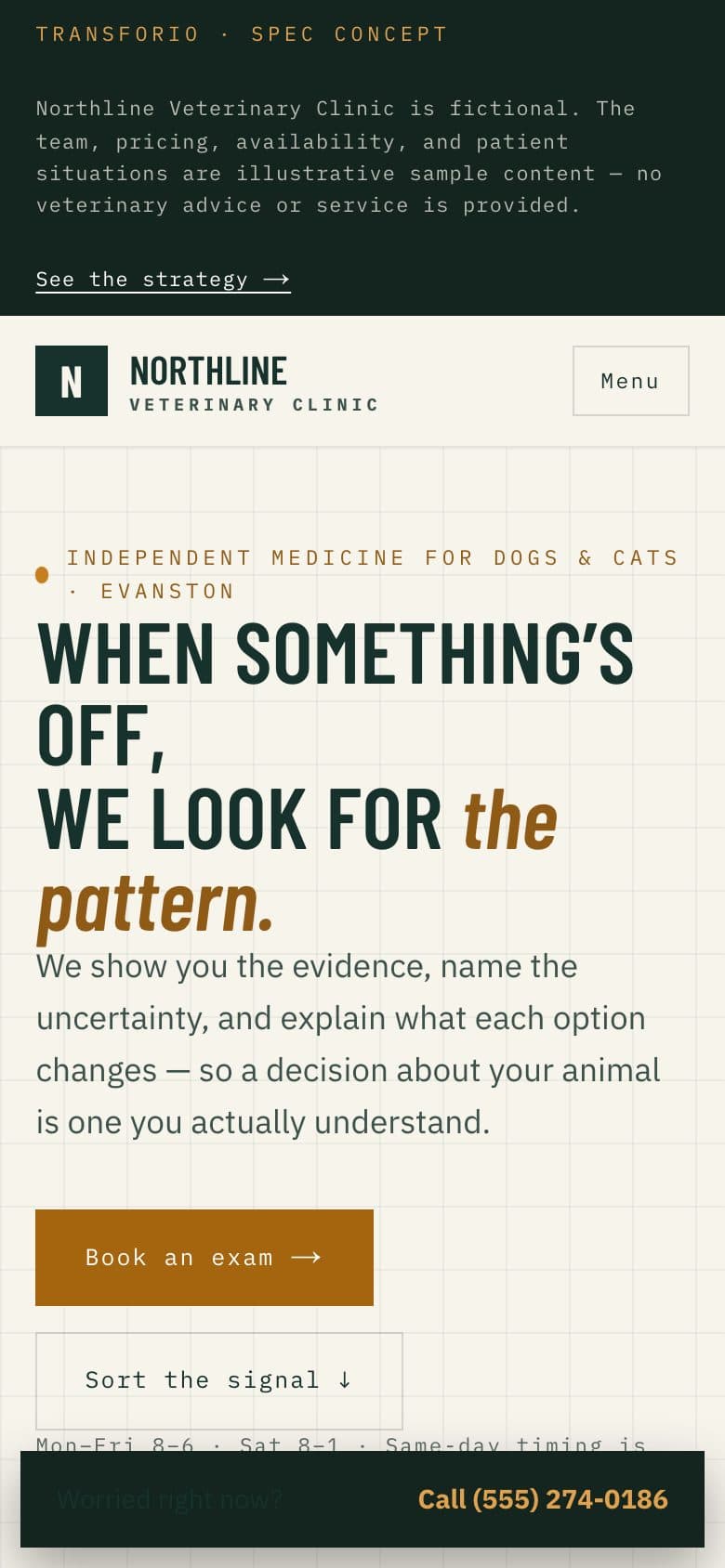
- An observation-log hero: the patient chart of 'Murphy, 9 y.o. Lab, presenting: just off' makes the diagnostic method tangible in the first screen.
- An interactive symptom field guide mapping five common symptoms to three timing lanes — routine, call today, emergency now — each with what to track and explicit escalation triggers.
- A five-question clinical-reasoning section, a decision brief listing the six things every visit ends with, and cat-considerate care as a named offering.
- Cost presented as visual range bars with honest fine print, plus a dedicated emergency-honesty section listing situations that need an emergency hospital immediately.
- A focused intake form capturing the pattern (what changed, when, what's been tracked) rather than a generic contact form, with a persistent mobile call path.
- Visible disclosures separating the fictional clinic, pricing, availability, and patient situations from Transforio's real strategy and design work.
- Hero → book an exam or sort the signal
- Symptom field guide → timing lane → request a visit
- Clinical reasoning → decision brief → trust in the method
- Cost ranges → reduced anxiety → intake form
- Emergency honesty → appropriate destination (trust preserved even when referred away)
- Intake form captures the observed pattern → confirmation call
- End-of-spec explanation → contact Transforio
Disclosure
Northline Veterinary Clinic, its team, address, phone number, pricing, availability, services, policies, credentials, and patient situations are fictional. This concept demonstrates Transforio's strategy and design judgment; it provides no veterinary advice, diagnosis, treatment, emergency response, or claim of business results.