- Premium restaurant websites often substitute a full-screen photograph and oversized logo for an actual point of view.
- The menu, atmosphere, story, and reservation path are separated into predictable landing-page blocks that never recreate the feeling of an evening in the room.
- Generic luxury styling—black backgrounds, gold rules, empty dining rooms, and scripted food language—can make independent restaurants feel interchangeable.
- Important operating details such as walk-in availability, accessibility, hours, seating, and late-arrival expectations are frequently buried or missing.
- Reservation calls to action either overwhelm the experience or disappear when a guest is ready to act.
TRANSFORIO / QA
Releasechecked
CALDER- QC-01Works on every screenNo sideways scrolling at 390, 768, 1440 px wide, on its page.PASS
- QC-02Accessibility0 WCAG 2.1 A/AA or best-practice violations from axe-core on its page, re-checked in every open menu, tab and panel at desktop and phone width. A skip link comes first, every keyboard stop shows focus, and tab widgets answer to arrow keys.PASS
- QC-04SEO fundamentalsTitle, description, a single main heading, language and viewport are set on its page.PASS
- QC-06Links2 internal links checked; none broken.PASS
Automated checks on every page found by crawling the production build, run October 1, 2026. Speed is measured on live hosting at launch, and forms are tested end to end, so neither is claimed here.
Make the website feel like entering the restaurant.
The exercise was not to produce another polished restaurant template. It was to turn atmosphere, service, food, and operational clarity into one memorable evening that still makes reserving effortless.
- Business
- Independent premium neighborhood restaurant
- Audience state
- Choosing where an evening should happen—not merely comparing menus
- Primary offer
- A specific room, cooking point of view, and style of hospitality
- Decision barriers
- Atmosphere, menu fit, availability, walk-ins, access, and ease of booking
- Signature concept
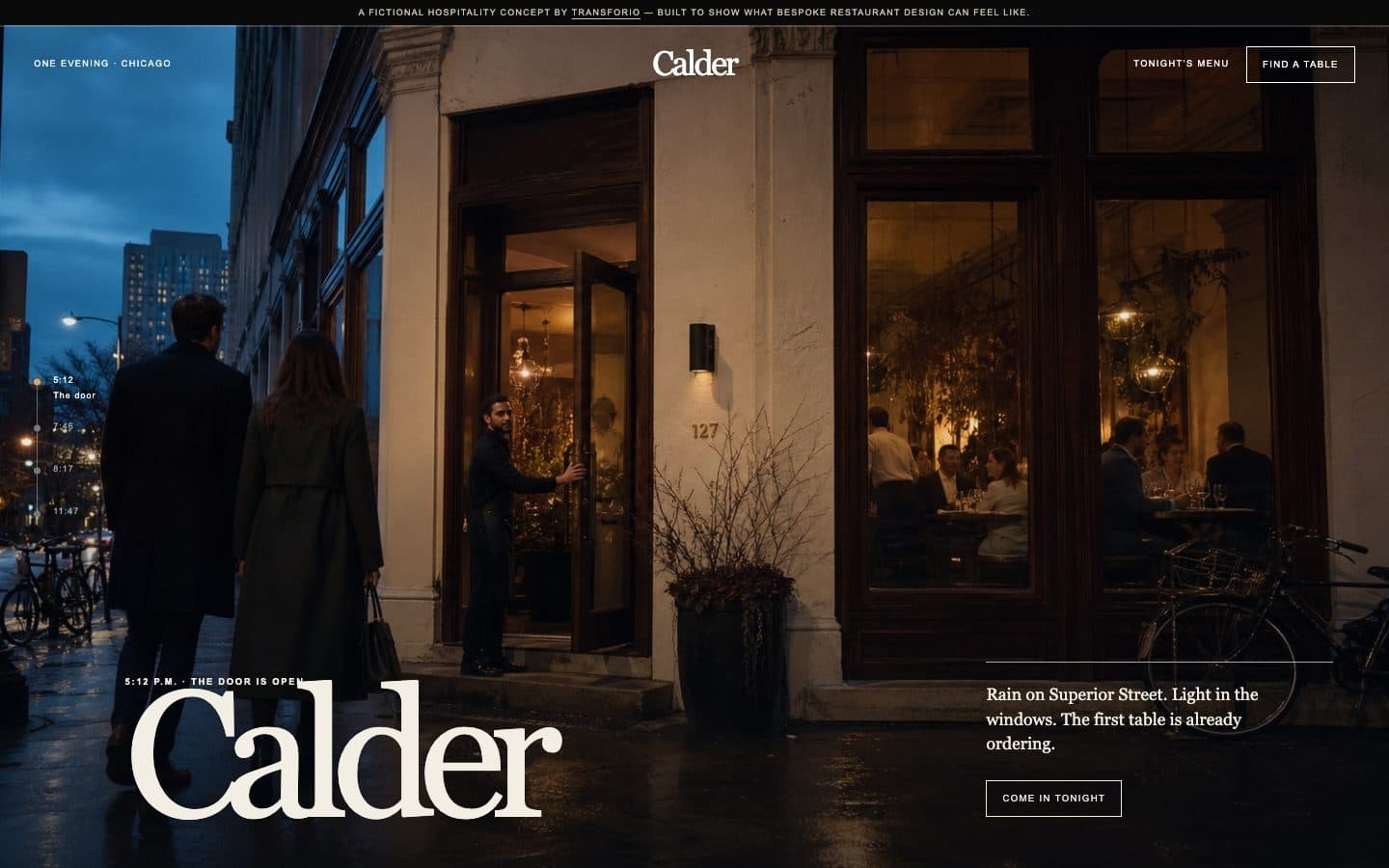
- One evening, unfolding from 5:12 p.m. to 11:47 p.m.
- Industry visual system
- A restrained hospitality system built from cinematic documentary scenes, candlelit black, warm plaster, oxblood, moss, and amber. A persistent evening timeline, editorial menu typography, full-screen image chapters, and quiet transitions give the restaurant a specific sense of pace without relying on cards, generic luxury cues, or tasting-menu theater.
The restaurant is the experience. The interface should know when to disappear.
Every choice protects the emotional arc while keeping essential guest information and the reservation path close at hand.
- Structure the website as one continuous evening rather than a conventional collection of restaurant sections.
- Use four specific moments—arrival, peak service, the plate, and the final table—to establish desire through lived atmosphere.
- Present the menu as an order unfolding in time instead of a generic grid or downloadable PDF.
- Keep the reservation action continuously available but visually subordinate to the restaurant experience.
- Use operational candor about walk-ins, hours, accessibility, and table expectations as part of premium hospitality.
- Clearly identify the restaurant, address, people, menu, and availability as fictional while treating the strategy and execution as real.
From the first unlocked door to the final glass.
The result demonstrates a more valuable kind of restaurant website: emotionally specific, operationally useful, unmistakably authored, and always one quiet action away from a table.
- A responsive single-page experience organized around a four-point evening timeline.
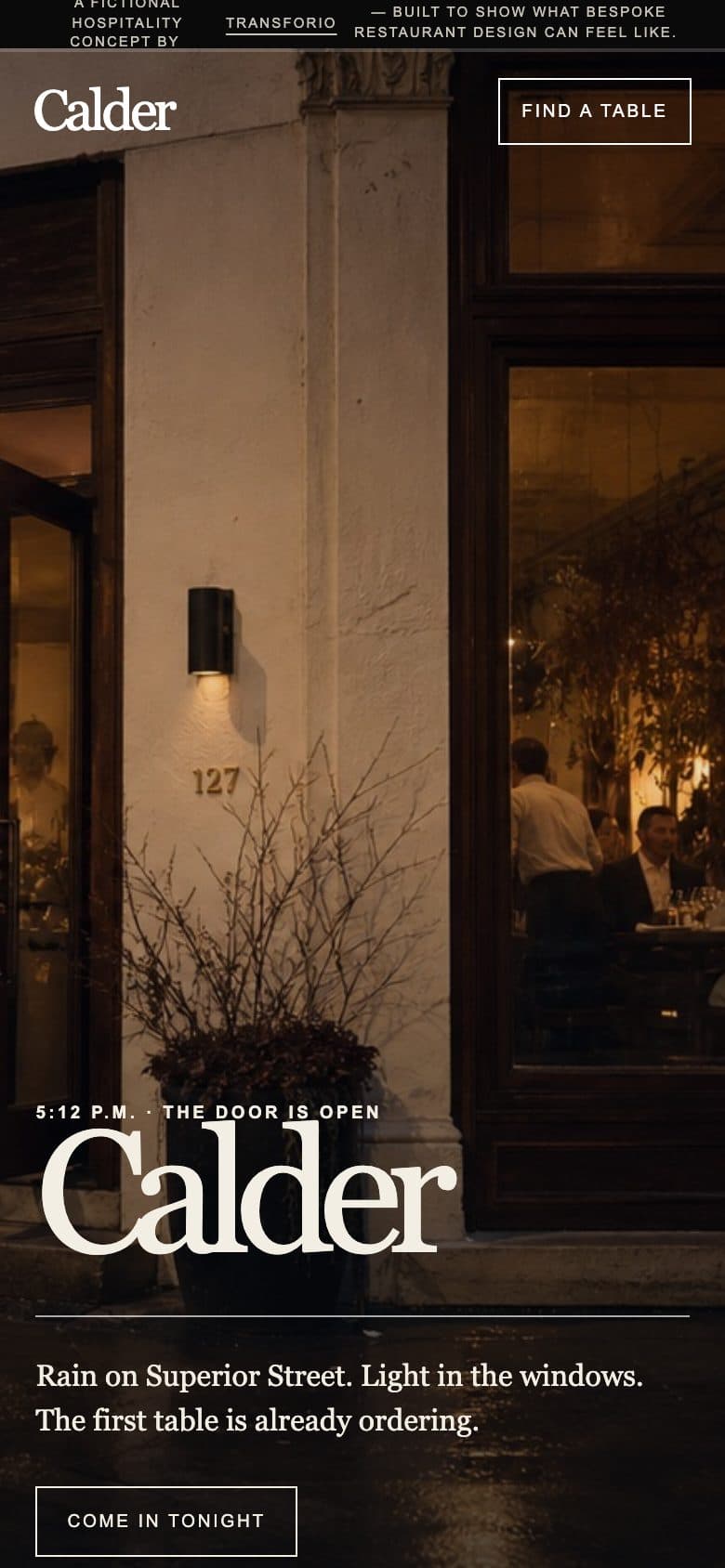
- Four original documentary-style scenes covering blue-hour arrival, active service, dinner at the table, and the end of the night.
- Sticky cinematic chapters with chapter-aware navigation and a restrained reading-progress indicator.
- An editorial à la carte menu that preserves prices, descriptions, and natural ordering rhythm.
- A keyboard-accessible reservation drawer with date, party, time, seating, and guest-note controls.
- Reduced-motion support, responsive mobile compositions, structured metadata, and explicit fictional-concept disclosure.
- Blue-hour arrival → feel the warmth and possibility of entering
- Peak service → understand the room, bar, and walk-in experience
- Evening order → evaluate the food without leaving the narrative
- Featured plate → turn menu interest into appetite and specificity
- Restaurant story → understand why the room feels accumulated rather than installed
- Final table → connect hospitality with lingering, not table-turn pressure
- Visit details → resolve hours, location, access, and walk-in questions
- Reservation drawer → request a table without breaking the experience
Disclosure
Calder, its address, team, menu, prices, availability, and operating history are fictional. The original images are illustrative scenes created for this showcase. This concept demonstrates Transforio's real strategy, writing, art direction, design, implementation, and quality judgment; it is not a restaurant client engagement or a claim of business results.